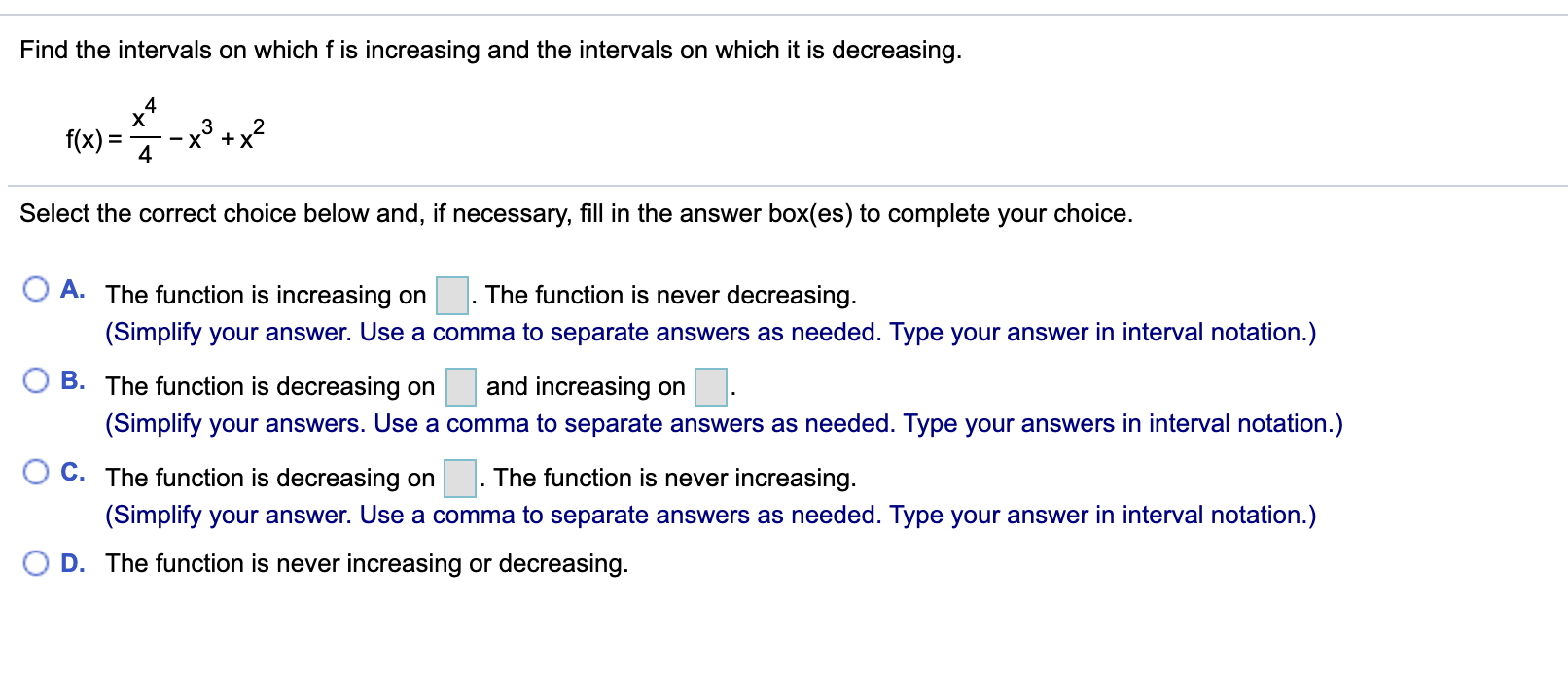
Find The Intervals On Which F Is Increasing And Decreasing . If f ′ ( x) > 0 on an open interval, then f is increasing on the interval. Find the intervals in which `f (x)=s in\ x (1+cosx),\ \ 0<x<pi/2` is increasing or decreasing:
Solved Find The Intervals On Which F Is Increasing And The | Chegg.com from www.chegg.com
If f′(x) > 0, then f is increasing on the interval, and if f′(x) < 0, then f is decreasing on the interval. If f(x) < 0, then the function is decreasing in that particular interval.
Solved Find The Intervals On Which F Is Increasing And The | Chegg.com
(c) find the intervals of concavity and the inflection points. One of the major applications of derivatives is determining the monotonicity of a given function in a specific interval. Find the intervals in which.
Source: www.nagwa.com
If f(x) > 0, then the function is increasing in that particular interval. The derivative of a function may be used to determine whether the function is increasing or decreasing on any intervals in its domain. Determining intervals on which a function is increasing or decreasing.
Source: www.chegg.com
The function is increasing onthe function is never decreasing. (a) find the intervals on which $ f $ is increasing or decreasing. Recall that, if f ' > 0 on a given interval, then f is increasing on that interval, and when f ' < 0 on a given interval, then f is decreasing on that interval.
Source: www.youtube.com
If f' (c) > 0 for all c in (a, b), then f (x) is said to be increasing in the interval. This is the currently selected item. To find increasing and decreasing intervals, we need to find where our first derivative is greater than or less than zero.to find intervals on which \(f\) is increasing and decreasing:to find the.
Source: www.cuemath.com
(b) find the local maximum and minimum values of $ f $. Reading the function from left to right we can see that the function goes up. So if we want to find the intervals where a function increases or decreases, we take its derivative an analyze it to find where it’s positive or negative (which is easier to do!).
Source: www.youtube.com
(c) find the intervals of concavity and the inflection points. Find the intervals in which `f (x)=s in\ x (1+cosx),\ \ 0<x<pi/2` is increasing or decreasing: If f ′ ( x) < 0 on an open interval, then f is decreasing on the interval.
Source: www.chegg.com
Finding increasing interval given the derivative. If 𝑓 is differentiable on an open interval, then 𝑓 is increasing on intervals where 𝑓 ′ ( 𝑥) > 0 and decreasing on intervals where 𝑓 ′ ( 𝑥) 0.in the graph above, the graph increases over the part that is.know how to use the rst and second derivatives of a function to.
Source: www.nagwa.com
Find the intervals on which f is increasing or decreasing. So hopefully that gives you a sense of things. List the intervals on which the function is increasing and decreasing.
Source: www.chegg.com
So f of x is decreasing for x between d and e. F (x) = (2 x − 1) (2 x − 2) 2 The function is increasing on and decreasing on o b.
Source: www.slideshare.net
(c) find the intervals of concavity and the inflection points. By the sum rule, the derivative of with respect to is. The part of the graph corresponding to this interval is also shown.
Source: www.khanacademy.org
Ponder the graphs in the box above until you are confident of why the two conditions listed are true. F(𝑥) = sin 3𝑥 where 𝑥 ∈ [0 ,𝜋/2]finding f’(x)f’(𝑥) = 𝑑(sin3𝑥 )/𝑑𝑥 f’(𝑥) = cos 3𝑥 × 3 f’(𝒙) = 3. The original function f is increasing on the intervals for which f ′ ( x) > 0, and decreasing.
Source: www.nagwa.com
Finding intervals of increasing and decreasing. Reading the function from left to right we can see that the function goes up. Analytically, we find these intervals using the following process:
Source: www.chegg.com
Find the intervals on which f is increasing and the intervals on which it is decreasing. (c) find the intervals of concavity and the inflection points. If f(x) > 0, then the function is increasing in that particular interval.
Source: mathematica.stackexchange.com
Finding increasing interval given the derivative. This is the currently selected item. Finding intervals of increasing and decreasing.
Source: www.youtube.com
(b) find the local maximum and minimum values of $ f $. $ f(x) = \frac{x}{x^2 + 1} $ The derivative of a function may be used to determine whether the function is increasing or decreasing on any intervals in its domain.
Source: www.nagwa.com
That we are, the intervals where we're positive or negative don't perfectly coincide with when we are increasing or decreasing. (b) find the local maximum and minimum values of f. $ f(x) = \frac{x}{x^2 + 1} $
Source: www.youtube.com
If f' (c) > 0 for all c in (a, b), then f (x) is said to be increasing in the interval. So hopefully that gives you a sense of things. Ponder the graphs in the box above until you are confident of why the two conditions listed are true.
Source: study.com
Finding decreasing interval given the function. (c) find the intervals of concavity and the inflection points. So if we want to find the intervals where a function increases or decreases, we take its derivative an analyze it to find where it’s positive or negative (which is easier to do!).
Source: www.khanacademy.org
If f ′ ( x) > 0 on an open interval, then f is increasing on the interval. We use this test in several ways. So hopefully that gives you a sense of things.
Source: courses.lumenlearning.com
(b) find the local maximum and minimum values of $ f $. (c) find the intervals of concavity and the inflection points. The original function f is increasing on the intervals for which f ′ ( x) > 0, and decreasing on the intervals for which f ′.
Source: www.chegg.com
(c) find the intervals of concavity and the inflection points. (a) find the intervals on which f is increasing or decreasing. Find the intervals of increase and decrease of the, following functions.