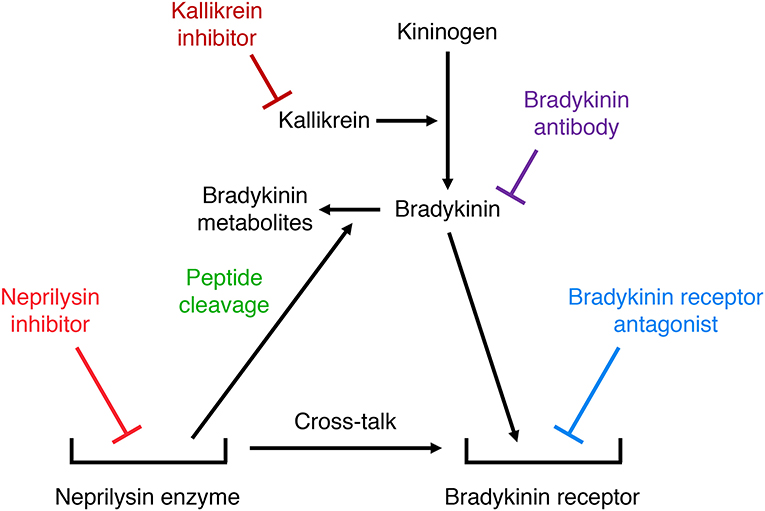
Which Part Of The Kidney Produces The Hormone Bradykinin . This system is composed by substrates (kininogens) and plasma and tissue kallikreins are the specific activators of these substrates producing two vasoactive peptides called bradykinin and kallidin. Kidney tissue → produce prostaglandins that regulate internal blood flow by vasodilation or vasoconstriction ii.
Frontiers | Chronic Overexpression Of Bradykinin In Kidney Causes Polyuria And Cardiac Hypertrophy | Medicine from www.frontiersin.org
Bradykinin is released from mast cells during asthma attacks, from gut walls as a gastrointestinal vasodilator, from damaged tissues as a pain signal, and may act as a neurotransmitter. 39 under physiologic conditions, most of the effects of bradykinin are mediated by the b 2 receptor.
Frontiers | Chronic Overexpression Of Bradykinin In Kidney Causes Polyuria And Cardiac Hypertrophy | Medicine
Prostaglandins are made at sites of tissue damage or infection, where they cause inflammation, pain and fever as part of the healing process. They do not typically influence blood pressure in healthy people. The right kidney often sits slightly lower than the left one because of the position of the liver.
Source: www.researchgate.net
Yu mb, bchir, in brenner and rector's the kidney, 2020bradykinin. Bradykinin is a potent vasodilatory peptide that is elevated in the remnant kidney 25 and may therefore contribute to hemodynamic adaptations after nephron loss. Renal bradykinin formation is normally low, and increases during sodium restriction and water deprivation.
Source: www.mdpi.com
Which part of the kidney produces the hormone bradykinin? Angiotensinogen is produced in the liver, but it is also formed in the cns, kidney, adrenal gland, leukocytes and heart. The adrenal glands (part of the endocrine system) sit on top of the kidneys and release a hormone called renin which helps to regulate blood pressure, and sodium (or salt) and.
Source: www.frontiersin.org
Bradykinin is released from mast cells during asthma attacks, from gut walls as a gastrointestinal vasodilator, from damaged tissues as a pain signal, and may act as a neurotransmitter. 39 under physiologic conditions, most of the effects of bradykinin are mediated by the b 2 receptor. Which part of the kidney produces the hormone bradykinin?
Source: www.sciencedirect.com
Adh plays a key role in the homeostatic process called osmoregulation 8. Kidney tissue → produce prostaglandins that regulate internal blood flow by vasodilation or vasoconstriction ii. Angiotensin ii, estrogen and glucocorticoids stimulate the synthesis of angiotensinogen.
Source: www.sciencedirect.com
The juxtaglomerular cells of the arterioles produce the hormone bradykinin , which increases blood flow and vascular permeability. Yu mb, bchir, in brenner and rector's the kidney, 2020bradykinin. The adrenal glands (part of the endocrine system) sit on top of the kidneys and release a hormone called renin which helps to regulate blood pressure, and sodium (or salt) and water.
Source: www.sciencedirect.com
39 under physiologic conditions, most of the effects of bradykinin are mediated by the b 2 receptor. The kidney parenchyma produces erythropoietin that stimulates the bone marrow to make red blood cells. The right kidney often sits slightly lower than the left one because of the position of the liver.
Source: www.frontiersin.org
Prostaglandins act as signals to control several different processes depending on the part of the body in which they are made. Kidney tissue → produce prostaglandins that regulate internal blood flow by vasodilation or vasoconstriction ii. Bradykinin is a potent vasodilatory peptide that is elevated in the remnant kidney 25 and may therefore contribute to hemodynamic adaptations after nephron loss.
Source: journals.physiology.org
Adh plays a key role in the homeostatic process called osmoregulation 8. 24 votes) bradykinin is produced by the action of kallikrein on kininogen, and is present in both the lumen of the cd and the interstitial fluid. The kidney parenchyma produces erythropoietin that stimulates the bone marrow to make red blood cells.
Source: www.slideshare.net
24 votes) bradykinin is produced by the action of kallikrein on kininogen, and is present in both the lumen of the cd and the interstitial fluid. Bradykinin is inactivated by a kininase, which also converts angiotensin i to angiotensin ii, a substance that causes the constriction of blood vessels. Bradykinin of renal origin is vasodilator and natriuretic.
Source: www.sciencedirect.com
Bradykinin of renal origin is vasodilator and natriuretic. Five subtypes of npy receptors have been cloned, among which y 1 , y 2 and y 5 appear to. The discovery of the kinin system is not recent, but its study in clinical field has been done only in the last years.
Source: www.nature.com
They do not typically influence blood pressure in healthy people. Adh is synthesised in the hypothalamus and stored in the pituitary gland e. Moreover, there is compelling evidence that plasmin, a fibrinolytic enzyme, is able to generate bradykinin after hmwk cleavage.
Source: www.researchgate.net
Reabsorbed by the kidneys b. Bradykinin is released from mast cells during asthma attacks, from gut walls as a gastrointestinal vasodilator, from damaged tissues as a pain signal, and may act as a neurotransmitter. The adrenal glands (part of the endocrine system) sit on top of the kidneys and release a hormone called renin which helps to regulate blood pressure,.
Source: www.mdpi.com
They are produced by endothelial cells of the renal blood vessels, mesangial cells, and cells of the dct. This system is composed by substrates (kininogens) and plasma and tissue kallikreins are the specific activators of these substrates producing two vasoactive peptides called bradykinin and kallidin. Kallikreins, a group of serine proteases that act on blood proteins to produce a vasorelaxing.
Source: www.amjmed.com
What part of kidney produces bradykinin? Renin is a protease produced by the kidneys in response to β 1 stimulation or hypotension, and exists to cleave angiotensinogen to angiotensin i ace cleaves angiotensin i to angiotensin ii, and also cleaves bradykinin into inactive metabolites Reabsorbed by the kidneys b.
Source: www.mdpi.com
The adrenal glands (part of the endocrine system) sit on top of the kidneys and release a hormone called renin which helps to regulate blood pressure, and sodium (or salt) and water retention. The juxtaglomerular cells of the arterioles produce the hormone bradykinin → increases blood flow & vascular permeability i. They do not typically influence blood pressure in healthy.
Source: www.frontiersin.org
Prostaglandins are made at sites of tissue damage or infection, where they cause inflammation, pain and fever as part of the healing process. Renin is a protease produced by the kidneys in response to β 1 stimulation or hypotension, and exists to cleave angiotensinogen to angiotensin i ace cleaves angiotensin i to angiotensin ii, and also cleaves bradykinin into inactive.
Source: journals.plos.org
Adh plays a key role in the homeostatic process called osmoregulation 8. Kidney tissue → produce prostaglandins that regulate internal blood flow by vasodilation or vasoconstriction ii. Bradykinin exerts its effects via b1 and b 2 receptors.
Source: link.springer.com
The kidney tissues produce prostaglandins that regulate internal blood flow by vasodilation or vasoconstriction. The enzyme kallikrein is produced and released from the distal convoluted tubule and connecting segment by exocytosis at both the apical and basolateral membranes, to the lumen and interstitial fluid, respectively. The function of angiotensinogen is a serine protease inhibitor.
Source: opentextbc.ca
Renin is a protease produced by the kidneys in response to β 1 stimulation or hypotension, and exists to cleave angiotensinogen to angiotensin i ace cleaves angiotensin i to angiotensin ii, and also cleaves bradykinin into inactive metabolites Bradykinin is released from mast cells during asthma attacks, from gut walls as a gastrointestinal vasodilator, from damaged tissues as a pain.
Source: www.researchgate.net
Prostaglandins are made at sites of tissue damage or infection, where they cause inflammation, pain and fever as part of the healing process. Angiotensin ii, estrogen and glucocorticoids stimulate the synthesis of angiotensinogen. The juxtaglomerular cells of the arterioles produce the hormone bradykinin → increases blood flow & vascular permeability i.